NFL Draft Betting for UK Punters
 Available in US
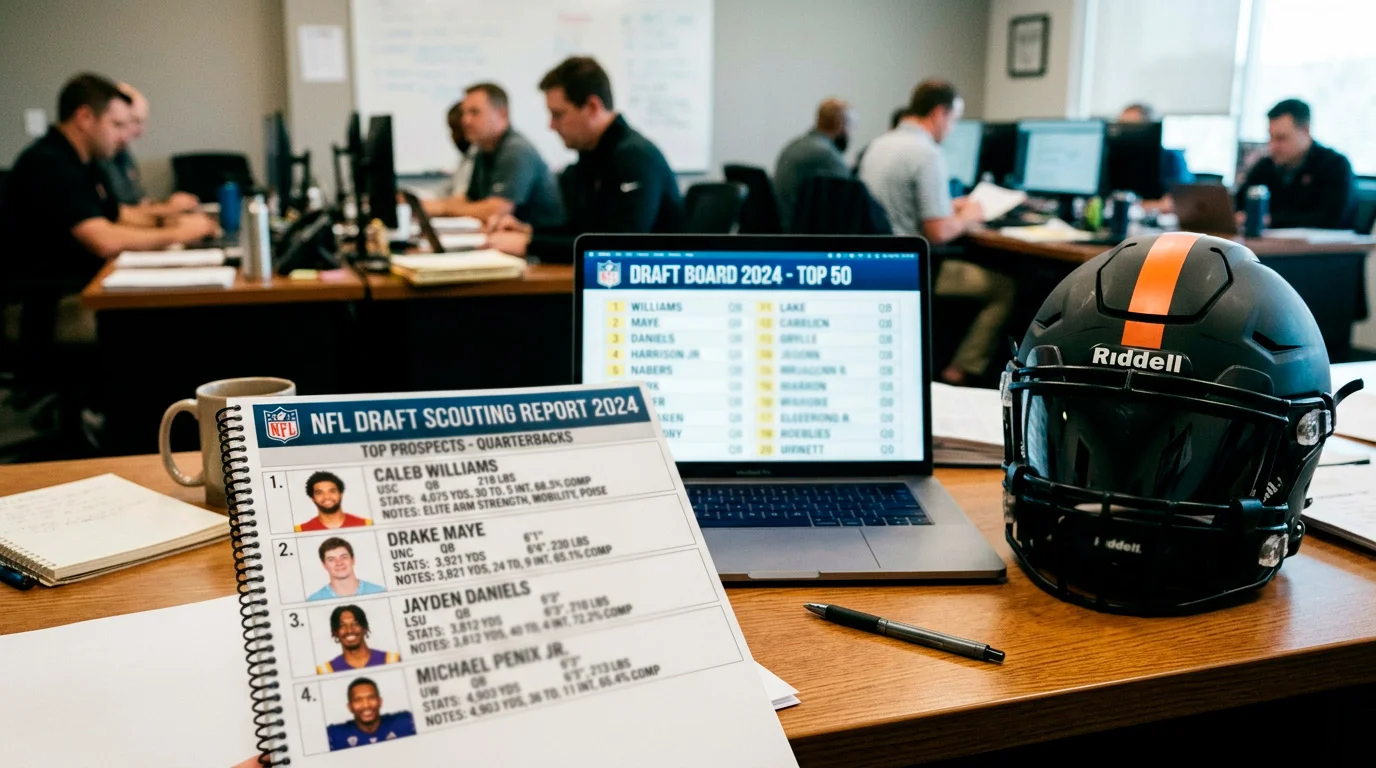
The 2024 NFL Draft taught me a lesson I should have learned years earlier. I had backed Caleb Williams as the first overall pick at 1/10 — practically a certainty — and spent the remaining research time building a more speculative bet on the third overall pick that offered much better value. Williams went first, as expected, and my second bet hit too. The lesson was not about picking winners. It was about where to allocate my attention. The first overall pick market is priced so tightly that the return barely justifies the risk. The real betting value in the draft sits in the markets that are harder to model — and those are the ones most UK punters ignore entirely.
The NFL Draft is a uniquely compelling betting event. Unlike a game, where the outcome hinges on execution and variance, draft picks are driven by information — scouting reports, medical evaluations, team needs, front-office relationships and rumours that may or may not be genuine smokescreens. For punters willing to sift through that information landscape, the draft offers pricing inefficiencies that simply do not exist in regular-season markets. The NFL staged a record 7 international games in 2025 with 9 planned for 2026, and the expansion of the league’s global footprint has brought the draft firmly into the UK betting conversation.
NFL Draft Betting Markets Available in the UK
UK bookmakers typically open draft markets in February or March, roughly two months before the event itself. The menu of available markets has expanded significantly in recent years, though it remains narrower than what American sportsbooks offer.
The headline market is first overall pick — who will be selected number one. This market is the most liquid and the most efficiently priced, which means it offers the least value. By the time the draft arrives, the first pick is usually a near-certainty, priced at odds so short that even a winning bet generates a minimal return. I treat the first overall pick market as entertainment rather than a serious betting proposition unless a genuine controversy exists between two candidates late in the process.
Over/under draft position markets are where the analysis gets interesting. The bookmaker sets a draft slot for a specific prospect — say, pick 7.5 — and you bet whether the player will be selected earlier (under) or later (over). These lines depend on team-specific needs and the cascading effect of earlier picks. If the first three teams all select defensive players, a top offensive prospect’s draft position drops. Modelling that cascade requires a depth of knowledge about team needs and board rankings that most casual fans do not possess, which creates genuine edges for anyone willing to do the work.
Positional markets — first quarterback selected, first wide receiver selected, first defensive player selected — offer another angle. These are easier to analyse than exact draft position because you only need to determine which player at a position goes earliest, not exactly when. The competition is between players at the same position rather than against the entire draft board.
Some UK operators list prop-style draft markets: total quarterbacks in the first round, total players from a specific university selected in round one, whether a trade will occur in the top five picks. These novelty markets carry wider margins but can offer genuine value when public perception diverges sharply from the information available to careful researchers.
Where to Research Draft Prospects
Mike Lombardi, a former NFL executive, once described American football as “chess on grass.” If regular-season NFL is chess, the draft is the chess clock — every decision is constrained by time, information and the moves your opponent has already made. Researching draft prospects for betting purposes follows a different path than researching them for fantasy football or fan interest.
Mock drafts are the starting point, but they require careful filtering. The major American draft analysts publish multiple mock drafts between February and April, and the consensus across 30 to 40 mocks provides a reasonable baseline for where each prospect is expected to land. I aggregate at least 20 mocks and look for consensus versus outlier picks. A prospect who is projected to the same team at the same slot in 85% of mocks is a reliable bet at reasonable odds. A prospect with a wide range — projected anywhere from pick 4 to pick 12 — is where speculative value hides.
Team needs analysis is the layer most UK punters skip. Each NFL team has specific positional needs based on its current roster, salary cap situation, coaching scheme and strategic priorities. A team with three starting-calibre wide receivers does not draft another one in the first round unless the value is extraordinary. Understanding these needs lets you eliminate implausible pick-to-team combinations that the bookmaker may still have priced into the line.
Trade rumours are the wild card. Draft-night trades happen frequently — multiple first-round picks change hands in most drafts — and they reshuffle the entire board. If a team is rumoured to be aggressively seeking to trade up, the players at the target position see their draft slot compress. I follow American NFL reporters who have genuine front-office sources, not aggregator accounts that amplify noise. The signal-to-noise ratio in draft coverage is atrocious, and separating credible reporting from speculation is a skill that directly translates to betting value.
Finding Value in Draft Odds
The best draft bet I ever placed was on a player nobody in the UK had heard of. A defensive tackle projected by consensus mocks at pick 22, but listed at a futures-style over/under of 17.5 at a UK bookmaker. I had read three scouting reports suggesting a team in the top 15 had him ranked significantly higher than consensus, and his combine performance supported a rise. He went 14th overall. The over hit comfortably and the odds were 11/10 — a value bet by any standard.
Value in draft betting clusters around information asymmetry. The UK market prices draft odds based on consensus projections from American media, but those projections are backward-looking by nature. Mock drafts published on 1 April do not account for private workouts, medical rechecks and front-office meetings that happen in the final three weeks before the draft. A punter who tracks that late-breaking information — team visits, private workout schedules, coach comments at press conferences — is operating with a real informational advantage over the market price.
Timing your draft bets is essential. Opening lines in February or March are set with maximum uncertainty and wider margins. As mock draft consensus solidifies through March and April, the prices tighten and the edges shrink. The sweet spot is typically two to three weeks before the draft — late enough that the major scouting evaluations are finalised but early enough that the final wave of team visits and smokescreens has not yet repriced the market. I place 80% of my draft bets in this window.
One structural advantage UK punters hold: the draft happens on a Thursday evening in the US, which is late Thursday night and into Friday morning in Britain. If you are watching the draft live, the first-round picks unfold in real time and you can place live bets on subsequent picks based on how the board has fallen. A surprise pick at number 5 cascades through every later selection, and UK operators do not always reprice their in-play draft markets as quickly as American sportsbooks. That latency is exploitable for anyone paying attention at midnight.
When do UK bookmakers publish NFL Draft odds?
Most UK bookmakers release NFL Draft odds between February and March, starting with the first overall pick market and expanding to include over/under draft position, positional markets and prop-style bets as the event approaches. Lines are updated throughout the pre-draft process as mock draft consensus shifts and new information emerges.
Can I bet on later rounds of the NFL Draft?
Betting on rounds two and three is available at some UK bookmakers, but coverage is significantly thinner than for round one. Later-round markets — rounds four through seven — are rarely offered at UK operators due to the extreme uncertainty involved and the low betting volume those markets would generate.
How does a trade affect my NFL Draft bet?
If a team trades its draft pick to another team, your bet on a specific player being selected at that pick number still stands — the bet is on the pick slot, not the team making the selection. For over/under draft position bets, trades that reshuffle the board can dramatically change the outcome, which is one reason late-breaking trade intelligence is so valuable for draft bettors.
Published by the Free nfl Bets team.