NFL Betting Tips for UK Punters
 Available in US
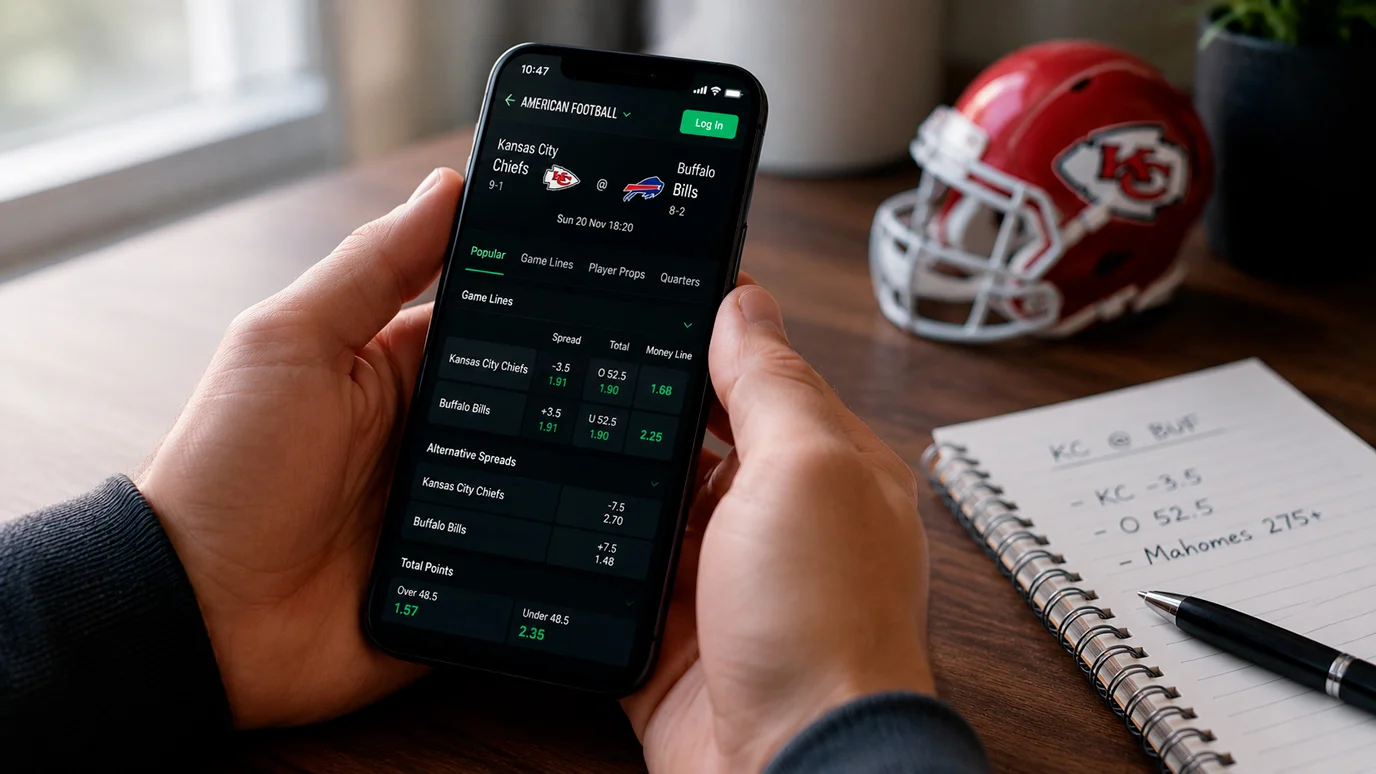
Turning Research Into Results
Legal wagers on the 2025 NFL season in the United States reached an estimated $30 billion, a figure that underlines just how much analytical effort flows into this sport every week. For UK punters, the depth of publicly available NFL data is both an advantage and a challenge. The advantage is that no other sport generates as much statistical material to work with. The challenge is knowing which data points actually move the needle and which are noise dressed up as insight.
I have been analysing NFL odds for UK markets for close to a decade, and the tips in this guide reflect what I have seen work consistently — not in theory, but in practice, across seasons and across different bookmaker platforms. None of these strategies guarantee profit. What they do is shift probability in your favour over a meaningful sample of bets, which is the only honest promise any betting analyst can make.
Line Shopping Across UK Bookmakers
If there is a single habit that separates profitable NFL bettors from the rest, it is line shopping. The concept is straightforward: before placing any bet, check the odds at multiple bookmakers and take the best available price. The execution, however, requires discipline and a willingness to maintain accounts at several operators.
In UK paid-search advertising for sports betting, William Hill commands roughly 38% of clicks, with Bet365 at around 16%. Those two operators alone account for more than half of the visible market, yet their NFL odds are not always the sharpest. Smaller bookmakers competing for market share sometimes offer better prices on specific games, particularly when they are trying to attract action on the less popular side of a matchup.
The difference between 10/11 and 5/6 on a point spread might look trivial on a single bet, but across a season of 50 or 100 wagers it compounds significantly. A bettor who consistently gets 10/11 instead of 5/6 retains substantially more profit over the long run. Think of line shopping as the betting equivalent of buying at wholesale rather than retail — same product, better price.
Maintaining three to five bookmaker accounts is usually sufficient for effective line shopping in NFL markets. I recommend including at least one exchange-style platform, where odds are often sharper because they are set by market participants rather than by the operator’s pricing team. The few minutes spent comparing prices before each bet is the highest-return activity in the entire betting process.
Situational Betting: Bye Weeks, Divisional Games and Primetime
Every NFL season contains recurring situations that create predictable patterns in team performance — and those patterns are not always fully priced into the odds. Recognising these spots and adjusting your approach accordingly is one of the most practical edges available to UK punters.
Teams coming off a bye week historically perform well against the spread. The extra week of preparation allows coaching staffs to install new schemes, rest injured players and address weaknesses exposed in previous games. The effect is not enormous — typically one to two points of additional value — but it is consistent enough to be worth noting when you see a post-bye team priced as a small underdog.
Divisional games — the six contests each team plays against its three division rivals — tend to be closer than the overall talent gap might suggest. Familiarity breeds competitive games, and divisional underdogs cover the spread at a slightly higher rate than non-divisional underdogs. If you are considering a bet on a divisional matchup, recognise that the underdog has a structural edge that non-divisional games do not provide.
Primetime games — Thursday Night Football, Sunday Night Football and Monday Night Football — have their own quirks. Thursday night games, played on a short week with limited preparation time, tend to produce lower-scoring affairs, making the under on totals a historically profitable angle. Monday night games attract disproportionate public money on the favourite, which can inflate the line and create value on the underdog side. These patterns are not guarantees, but they are data-backed tendencies that sharpen your decision-making when all other factors are roughly equal.
Scheduling letdowns are another situational factor. A team playing a marquee opponent the following week may underperform against a less glamorous opponent this week, particularly on the road. Coaching staffs insist this does not happen, but the data suggests otherwise. When you spot a letdown situation, it is worth at least questioning whether the favourite deserves its current price.
Bankroll Discipline and Staking
No collection of NFL betting tips is complete without addressing the money side. Analytical skill is worthless without a staking plan that keeps you in the game long enough for your edge to manifest. Since February 2025, UK bookmakers have been required to conduct financial vulnerability checks when a customer’s net deposits exceed 150 pounds over any rolling 30-day period — a regulatory development that reinforces the importance of setting personal limits before external checks force the issue.
The simplest effective approach is flat staking: risking the same fixed amount on every bet, regardless of confidence level. A common recommendation is 1-2% of your total bankroll per bet. If you start with a 500-pound bankroll, that means individual stakes of 5 to 10 pounds. This feels modest, and that is the point. Modest stakes protect you from the inevitable losing streaks that every bettor experiences, even those with a genuine analytical edge.
Variable staking — adjusting your bet size based on perceived edge — can increase returns but also increases variance and emotional pressure. If you choose to vary your stakes, keep the range narrow: perhaps 1% for standard bets and 2% for your strongest selections. The moment you find yourself staking 5% or more on a single bet because you “feel good” about a pick, you have abandoned discipline and entered the territory of gambling rather than wagering.
Tracking your bets in a simple spreadsheet is the single most underrated tool in a bettor’s arsenal. Record the date, the selection, the odds, the stake, the result and your closing profit or loss. After 50 bets, patterns emerge: you might discover that your spread bets are profitable but your totals bets are not, or that your Thursday night picks consistently underperform. Without records, you are navigating blind.
Prepared by the Free nfl Bets editorial staff.