NFL Bet Types Explained for UK Punters
 Available in US

The first NFL bet I ever placed was a moneyline on the New England Patriots, sometime around 2016. I picked them because I recognised the name. That is not a strategy — it is a lottery ticket with extra steps. What transformed my NFL betting from guesswork into something resembling a disciplined approach was understanding the mechanics behind each bet type, what each one actually measures and where value hides inside the odds.
UK punters coming from football or horse racing often assume NFL wagering works the same way. It does not. The American sports betting ecosystem developed its own vocabulary and its own market structures — point spreads, teasers, same-game parlays — that have no direct equivalent in Premier League betting. The overlap exists at a conceptual level (handicap betting maps loosely onto spreads, for instance), but the details diverge enough to trip up anyone who skips the fundamentals.
What follows is a walkthrough of every major NFL bet type available at UK bookmakers in 2026, starting with the simplest and building toward the more complex. Each section includes the mechanics, a worked example with realistic odds and an honest assessment of where that bet type sits on the risk-reward spectrum. Point spreads remain the preferred wager for 61 per cent of NFL bettors, but that does not mean spreads are where you should start or where you will find the best value. The right bet type depends on your knowledge, your risk appetite and the specific matchup in front of you.
Moneyline Bets: Picking the Winner
Strip everything else away and the moneyline is what remains: which team wins the game? No margins, no point differentials, no statistical thresholds. Your team wins by one point or by forty — the payout is the same.
At UK bookmakers, moneyline odds are typically displayed in fractional or decimal format. A team listed at 4/6 (decimal 1.67) is the favourite; you stake six pounds to win four. The underdog might sit at 11/10 (decimal 2.10) — stake ten to win eleven. The implied probability behind 4/6 is roughly 60 per cent, meaning the bookmaker believes that team wins six out of ten times. If you believe the true probability is higher than 60 per cent, the favourite offers value. If you think the underdog has a better than the implied 47.6 per cent chance, the underdog is where the edge sits.
Moneyline betting rewards patience and selectivity. The biggest trap for beginners is betting heavy favourites week after week. A team priced at 1/5 (decimal 1.20) needs to win more than 83 per cent of the time just to break even. In the NFL, where parity is real and any given Sunday applies more than in almost any other sport, teams priced at 1/5 do lose — and when they do, it wipes out weeks of accumulated profit in a single result. The moneyline shines brightest when you identify moderate underdogs in the 6/4 to 3/1 range who have a genuine path to victory — a strong defensive team facing a turnover-prone opponent, for example, or a divisional rivalry where the home underdog has a historical edge.
One quirk for UK bettors: NFL regular-season games cannot end in a draw (overtime rules ensure a winner), so moneyline is always a two-way market. This differs from football handicap markets, where the draw is a live outcome. The absence of the draw simplifies the maths and typically produces tighter margins.
Point Spread Betting in the NFL
If moneyline is “who wins,” the point spread is “who wins and by how much.” It is the backbone of NFL wagering in the United States and increasingly popular with UK punters who want more balanced odds than heavy-favourite moneylines typically offer.
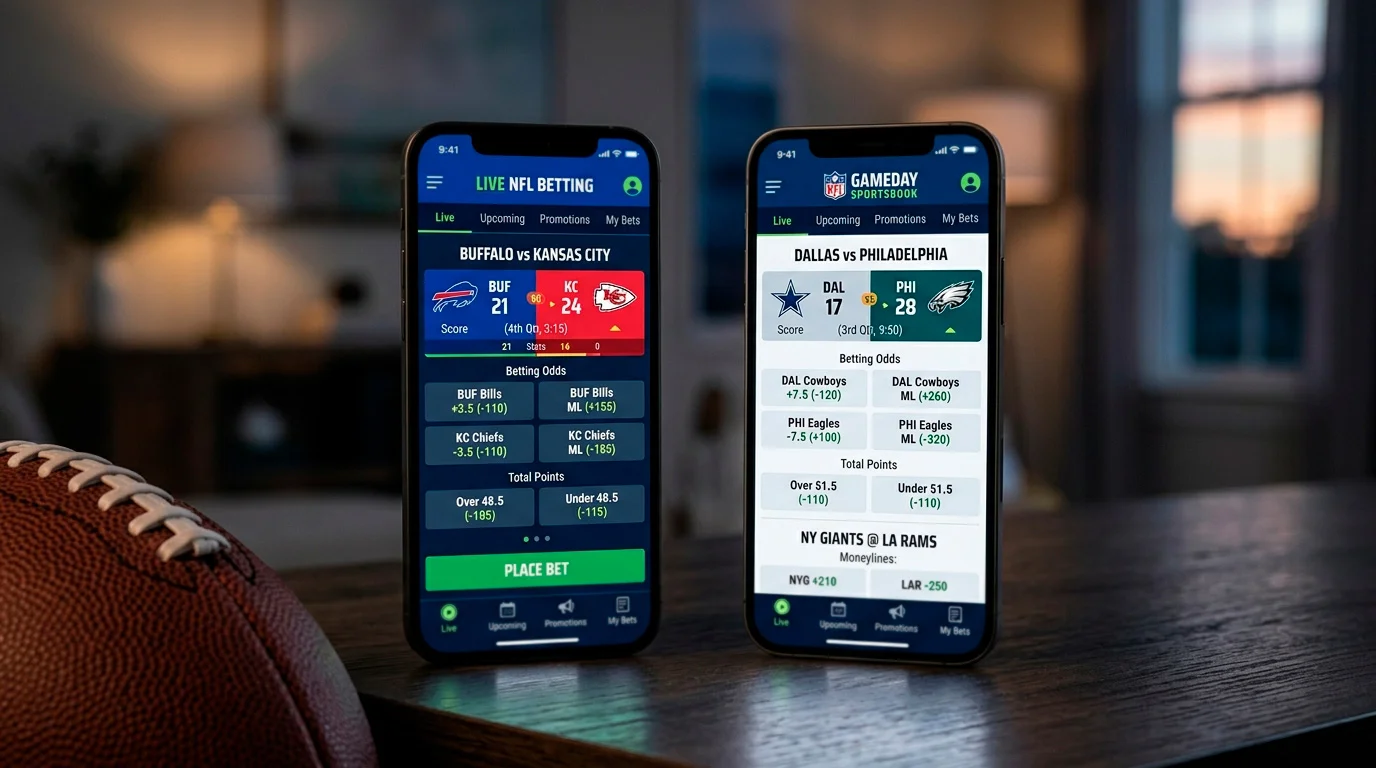
The concept is straightforward. A spread of -6.5 on Team A means that team must win by seven or more points for the bet to pay out. Conversely, Team B at +6.5 wins the bet if they lose by six or fewer — or win outright. The half-point eliminates the possibility of a push (a tied result against the spread), forcing a definitive outcome. When the spread is a whole number, such as -7, a win by exactly seven points returns your stake with no profit or loss.
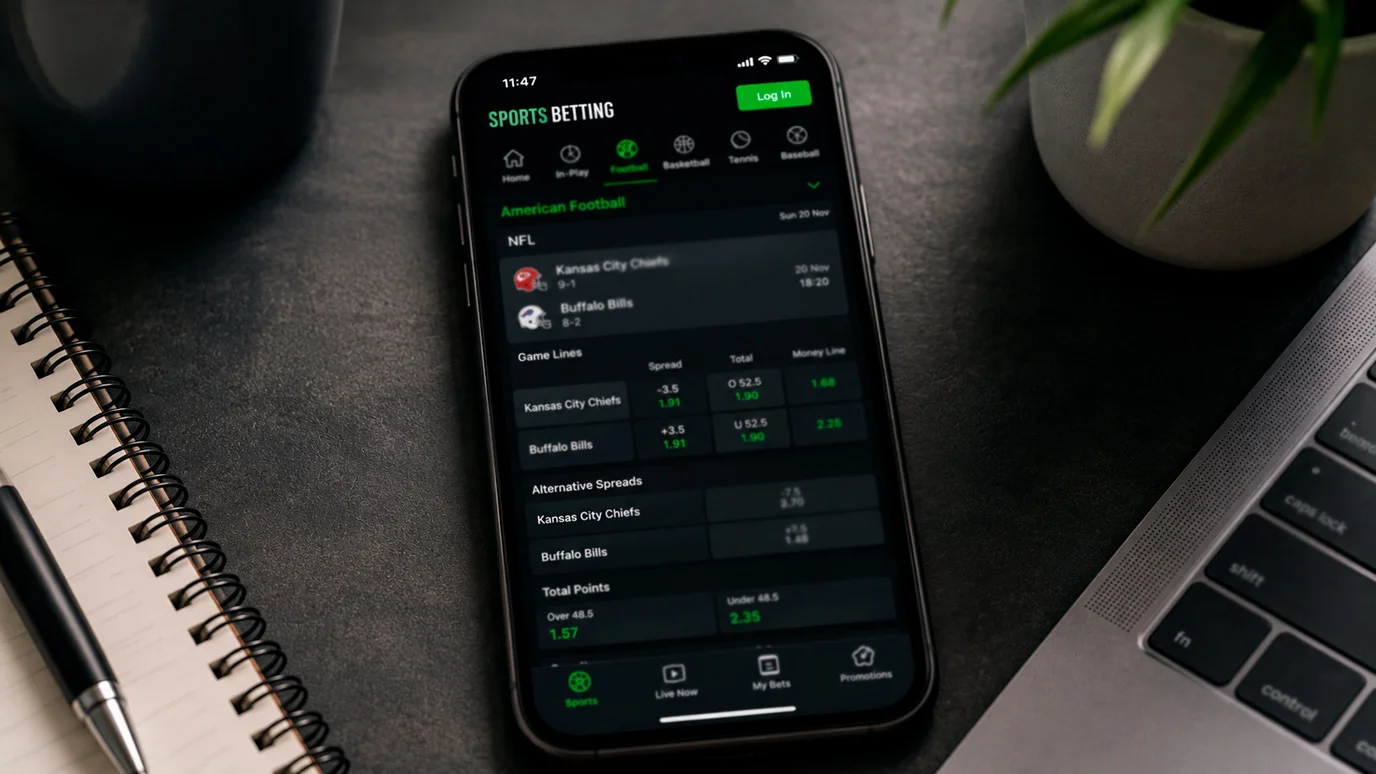
Here is a worked example. Suppose the Kansas City Chiefs are listed at -3.5, priced at 10/11 (decimal 1.91) on each side. You stake 20 pounds on the Chiefs -3.5. They win the game 24-20, a four-point margin. Because four is greater than 3.5, your bet wins. The payout: 20 multiplied by 1.91 equals 38.20 pounds, giving you 18.20 pounds profit. Had the Chiefs won 23-20, a three-point margin, your bet loses — they covered the result but not the spread.
Key numbers matter enormously in spread betting. The most common NFL final margins are three points (roughly 15 per cent of games historically land on a three-point margin) and seven points. A spread of -3 versus -3.5 is not a trivial half-point difference — it is the difference between a push and a loss on a significant chunk of outcomes. Experienced bettors pay close attention to line movement around these numbers. If a line opens at -3 and moves to -2.5, it tells you that money is coming in on the underdog, which can be an informational signal worth heeding.
For UK bettors used to Asian handicap in football, the mental model translates fairly well: NFL spreads function like a single Asian handicap line, except that ties on whole numbers result in a push rather than a void or half-win. The pricing structure is identical in principle — you are paying the bookmaker’s margin on both sides of the line rather than on a single outcome.
Over/Under (Totals) Bets
Some of the best NFL bets I have placed had nothing to do with which team won. Totals — also called over/under — ask a different question entirely: how many combined points will both teams score?
The bookmaker sets a line, say 44.5 points, and you decide whether the actual combined score will finish over or under that number. If the game ends 27-21 (48 total points), the over wins. If it ends 17-13 (30 total), the under wins. Pricing is usually close to even money on both sides, similar to spread bets.
Totals reward a type of analysis that has nothing to do with picking winners. You are studying pace of play, defensive efficiency, weather conditions, indoor versus outdoor venues and coaching tendencies. A game between two run-heavy, defence-first teams in December at Lambeau Field might carry a total of 38.5, while a September indoor matchup between two pass-happy offences might sit at 52.5. The range across an NFL slate can span 15 or more points, which reflects genuine variation in expected game scripts.
Weather is the X-factor that UK bettors from a football background sometimes underweight. Wind above 15 mph tangibly affects passing accuracy and field goal attempts, pushing scores lower. Rain and snow compound the effect. Late-season games in open-air northern stadiums — Buffalo, Green Bay, Chicago — regularly see totals move two to three points lower than early-season equivalents, and the under hits at a meaningfully higher rate in these conditions.
Beyond full-game totals, most UK bookmakers also offer first-half totals, team totals (how many points will one specific team score) and quarter-by-quarter totals. Team totals are particularly interesting because they let you isolate your opinion. If you believe one offence is elite but the opponent is mediocre, you can bet the team total over without taking a position on the other side. It adds a layer of precision that full-game totals lack.
Handicap Betting vs American Spread
UK bookmakers sometimes list NFL games with both a “point spread” and a “handicap” market, which causes genuine confusion. Are they the same thing? Almost — but the differences matter.
The American-style point spread is a two-way market. You pick one side of the line, and the only outcomes are win, lose or push. The European handicap, by contrast, is typically a three-way market: Team A wins by more than the handicap, Team B covers, or the result lands exactly on the handicap number (a draw against the handicap). That third outcome — the draw — changes the odds significantly, because the bookmaker is now pricing three possibilities instead of two.
In practice, most UK operators default to the American spread format for NFL, because it matches how the US market prices the game and it is simpler for bettors. The three-way European handicap appears less frequently, and when it does, it often carries wider margins because the draw outcome adds complexity and the market attracts less volume. If you see both options at your bookmaker, the two-way spread is almost always the sharper-priced product.
Asian handicap — familiar to anyone who bets on Premier League or Champions League matches — eliminates the draw by using half-point lines, exactly like an NFL spread. In fact, an Asian handicap of -3.5 on a football match functions identically to an NFL spread of -3.5: the favoured team must win by four or more. The only conceptual difference is that Asian handicap in football can use quarter-point lines (like -3.25, which splits the stake between two adjacent half-points), while NFL spreads very rarely deviate from whole or half-point increments.
Parlays and Accumulators
The parlay — known as an accumulator or “acca” in British betting parlance — is where disciplined bettors and reckless ones part company. I will be honest: I have won some thrilling parlays over the years, and I have lost far more. The maths explains why.
A parlay combines two or more individual selections into a single bet. All legs must win for the bet to pay out. The appeal is obvious: odds multiply. A three-leg parlay at 10/11 per leg returns roughly 6/1, turning a 10-pound stake into a 70-pound payout. A four-legger approaches 14/1. The numbers are seductive, and they are also the reason bookmakers love parlays — the house edge compounds with every leg you add. On a four-leg parlay priced at 10/11 per side, the bookmaker’s theoretical margin jumps from around 4.5 per cent on a single bet to over 17 per cent on the combination.
That does not mean parlays are inherently bad bets. It means you need to be extremely selective about when and how you use them. Two-leg or three-leg parlays built from well-researched, uncorrelated outcomes offer a reasonable risk-reward profile. By “uncorrelated,” I mean selections that do not influence each other — Team A covering their spread in the early window has no bearing on Team B covering theirs in the late window. If your legs are correlated (both teams in the same game, or two teams that share a divisional standing implication), you are introducing hidden dependencies that the parlay price may not fully reflect.
Acca insurance promotions, where the bookmaker refunds your stake as a free bet if one leg lets you down, shift the expected value calculation back in your favour on larger accumulators. But read the terms: most insurance offers cap the refund, require minimum odds per leg, and pay back in free bet tokens rather than withdrawable cash. Use them when they align with bets you would place anyway — never let the existence of insurance tempt you into adding a speculative fourth or fifth leg.
Teaser Bets: Adjusted Spreads
Teasers are parlays with a twist: you get to move the point spread in your favour on every leg, but you pay for that advantage with reduced odds. Think of it as buying insurance across multiple games simultaneously.
The standard NFL teaser gives you six extra points on each leg. If a team is -7.5 on the spread, a six-point teaser moves your line to -1.5. If the total is 44.5, you can tease it down to 38.5 for the under or up to 50.5 for the over. The minimum is usually two legs, and the typical payout for a two-leg, six-point teaser is around 10/11 — close to even money, which reflects the significantly higher probability of each adjusted leg hitting.
Where teasers get interesting is at key numbers. Moving a spread from -7.5 through both 7 and 6 to -1.5 crosses two of the most common final margins in NFL history. Moving +1.5 to +7.5 does the same in reverse. Those crossings are not equally valuable — crossing 3 is worth more than crossing 5, because roughly 15 per cent of NFL games land on a three-point margin while fewer than 5 per cent land on five. The “Wong teaser” strategy, named after gambling author Stanford Wong, specifically targets legs that tease through both 3 and 7, maximising the probability gain for the price paid. While the edges are thinner than they were a decade ago, the underlying logic remains sound.
Not every UK bookmaker offers teaser markets on the NFL, and availability can be inconsistent even among those that do. Check before the season starts whether your preferred platform supports teasers, and confirm the teaser sizes available (six, six-and-a-half, seven points are the common options) along with the corresponding payouts. The payout structure varies more across operators than most bettors realise — and that variation is where edge lives or dies.
Player and Game Props
Former NFL executive Mike Lombardi once described American football as “chess on grass.” Props are where that chess analogy becomes most tangible for bettors, because they let you wager on individual pieces rather than the final result of the board.
Player props cover statistical outputs for individual athletes: passing yards, rushing yards, receiving yards, completions, touchdowns, interceptions, tackles and more. Game props address team or match-level events that do not necessarily determine the winner: first team to score, total sacks in the game, whether there will be a safety, the margin of victory band. The range is enormous — a primetime NFL game at a well-stocked UK bookmaker can carry 50 or more individual prop markets.
The appeal for analytical bettors is that props expose inefficiencies more readily than main markets. A point spread is scrutinised by thousands of sharp bettors and algorithms worldwide, making it extremely efficient. A prop on a tight end’s receiving yards, by contrast, attracts far less volume and far less sophisticated pricing, which means the odds are more likely to be “off” in your favour. The flip side is that bookmaker margins on props tend to be wider — you are paying for the privilege of betting into a less efficient market.
To bet props well, you need granular information: how many targets does a receiver see per game? What is the opposing defence’s ranking against the pass? Is the starting cornerback on the injury report? This level of research is more demanding than checking a spread, but it is also more rewarding when you find genuine mismatches. I have found consistent value in rushing props for backup running backs who are expected to see increased volume due to a starter’s injury — a scenario where the market often underadjusts the line.
A word of caution: combining multiple props into a same-game parlay is fun and occasionally lucrative, but the legs are frequently correlated. A quarterback throwing for 300+ yards is more likely in a game that goes over the total, and the bookmaker’s pricing of same-game parlays accounts for some but not all of that correlation. Understand the relationships between your legs before you build.
Futures and Outright Bets
In February 2026, the American Gaming Association projected that legal Super Bowl bets would reach 1.76 billion dollars — a figure that underlines just how much money flows into NFL futures markets. While the UK handle is a fraction of that, the same market structures are available at most UKGC-licensed bookmakers, and they open months before the season even starts.
NFL futures cover long-term outcomes: Super Bowl winner, conference champion, division winner, regular-season MVP, Offensive and Defensive Rookie of the Year, and season win totals (over/under a set number of victories for each team). These markets open as early as the day after the previous Super Bowl and remain live, with continuously adjusting odds, throughout the season.
The core trade-off with futures is liquidity versus value. Early in the off-season, odds are at their most generous because uncertainty is highest — a team that just drafted a franchise quarterback might be 40/1 for the Super Bowl in April and 12/1 by September if preseason goes well. Betting early locks in that value, but it also ties up your stake for months with no possibility of partial cash-out at most operators. Betting later gives you more information (training camp reports, preseason performances, injury news) but shorter odds.
Season win totals deserve special attention because they offer a unique analytical advantage. The line is set based on projected strength of schedule, roster moves and coaching changes — all of which are knowable to a diligent bettor. If you believe a team’s schedule is softer than the market thinks, or that a new coaching hire will have a bigger impact than consensus expects, win totals let you express that opinion without needing to predict specific game outcomes. It is a slower, quieter market than weekly spreads, but it can be deeply satisfying when your off-season research pays off five months later.
Choosing the Right Bet Type for Your NFL Strategy
Every bet type I have covered here has a purpose, a risk profile and a context in which it makes sense. Moneylines reward conviction on outright winners. Spreads test your read on margins. Totals let you sidestep the question of who wins entirely. Props unlock individual player analysis, and futures reward off-season homework. The worst approach is defaulting to one type out of habit — the best is matching the bet type to the specific edge you believe you have identified in a given matchup. Start with the market where your knowledge is deepest, learn its rhythms across a full season, and expand from there.
What is the difference between a spread bet and a handicap in NFL?
An American-style point spread is a two-way market where you pick one side of a line, with outcomes of win, lose or push. A European handicap is a three-way market that includes the possibility of the result landing exactly on the handicap number as a separate outcome (a draw against the handicap). Most UK bookmakers default to the two-way spread format for NFL, which typically carries tighter margins.
Can I combine different bet types in one NFL wager?
Yes. Most UK bookmakers with bet-builder or same-game parlay functionality allow you to combine a spread selection, a total, and one or more player props within a single game into one bet. You can also build traditional accumulators across multiple games using different bet types for each leg. Be aware that combining correlated selections — such as a team to cover a spread and the game to go over the total — introduces dependencies that affect the true probability.
What does ‘push’ mean in NFL spread betting?
A push occurs when the final margin lands exactly on the spread number. For example, if the spread is -7 and the team wins by exactly seven points, the bet is a push and your stake is returned in full. Half-point spreads such as -7.5 eliminate the possibility of a push, which is why they are more common than whole-number spreads at many bookmakers.
Which NFL bet type has the lowest bookmaker margin?
Point spreads and full-game totals typically carry the lowest bookmaker margins among NFL bet types, with payout rates often between 93 and 96 per cent at competitive UK operators. Player props and exotic markets tend to have wider margins, with payout rates sometimes dropping below 90 per cent. Moneylines on lopsided matchups also carry wider margins due to the heavy juice on short-priced favourites.
Written by the editors at Free nfl Bets.