NFL Prop Bets at UK Bookmakers
 Available in US
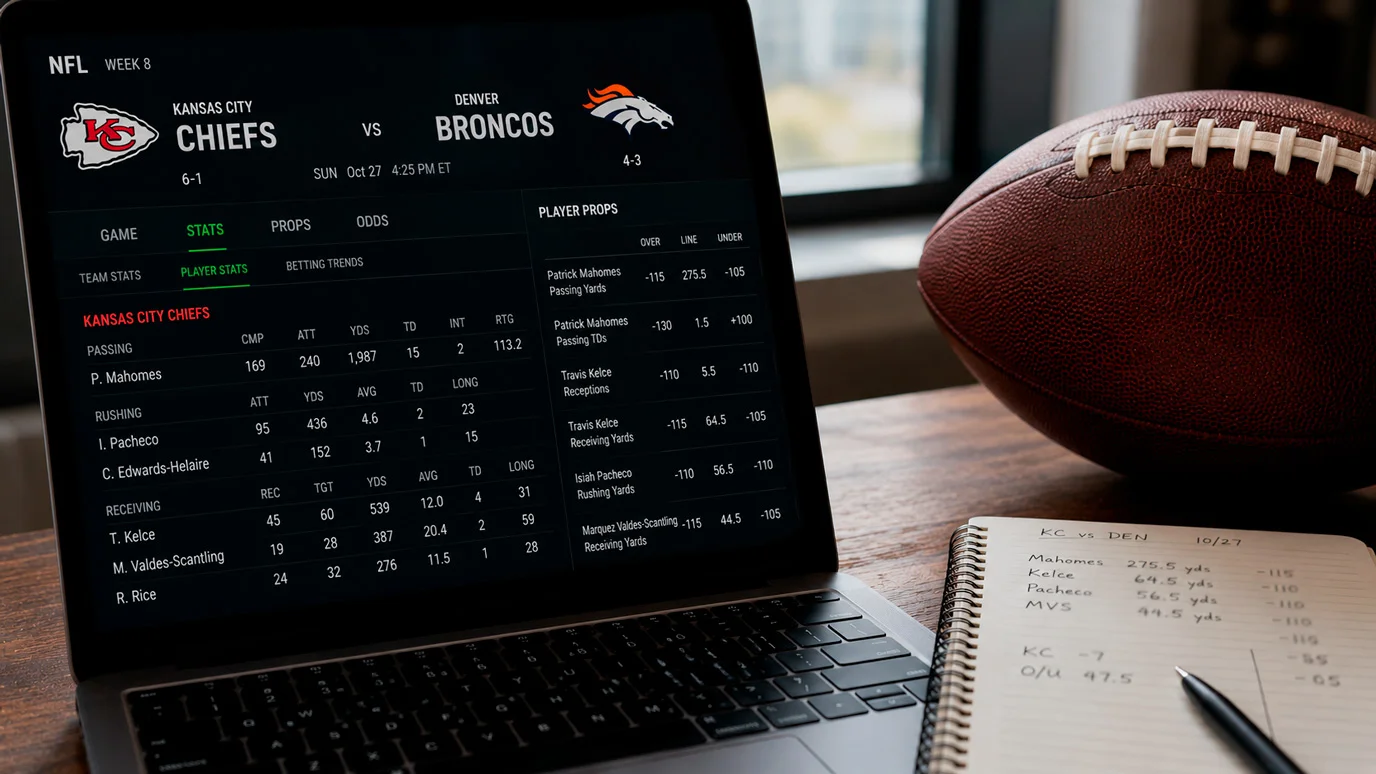
I placed my first NFL prop bet in 2018 on a Thursday night game nobody cared about — Patrick Mahomes over 285.5 passing yards against a leaky Denver secondary. He threw for 303 and I collected a payout that felt entirely too easy. That single bet changed the way I watched football. Suddenly every snap had financial weight, every third-down conversion mattered beyond the scoreboard, and I found myself dissecting matchups with a focus I never had when betting on simple outcomes.
Proposition bets — props for short — strip away the binary win-or-lose framework and let you wager on individual performances and specific in-game events. Point spreads remain the preferred bet type for 61% of NFL bettors, but props are where the sharpest edges hide because bookmakers spread their attention thinner across hundreds of player lines each week. For UK punters, prop markets have expanded dramatically over the past three seasons, with most UKGC-licensed operators now listing 50 to 100 individual prop lines per NFL fixture during the regular season.
This guide breaks down how player props, game props and team props work at UK bookmakers, and — more importantly — where value tends to cluster for anyone willing to do the homework.
Player Prop Markets in the NFL
A mate of mine bets exclusively on player props. No spreads, no moneylines, no accumulators. Just players and numbers. He has been profitable for three consecutive seasons, and when I asked him why, his answer was blunt: “I only need to know one player better than the bookmaker does. I don’t need to predict a whole game.” That logic is hard to argue with.
Player props revolve around individual statistical outputs. The bookmaker sets a line — say, a quarterback’s passing yards at 248.5 — and you decide whether the actual number will land over or under that mark. The “.5” eliminates pushes, so there is always a winner. The most widely available player prop categories at UK betting sites break down into three core positions.
Quarterback props dominate the market. You will find passing yards, passing touchdowns, interceptions, rushing yards and sometimes completions. These lines are the tightest because bookmakers model them most carefully, but that does not mean they are unbeatable. Weather, injury reports released after the line is posted and defensive matchup data create regular pricing errors — especially in early-season weeks when sample sizes are small.
Running back and wide receiver props come next. Rushing yards, receiving yards, receptions and anytime touchdown scorer markets are the bread and butter. Receiving props on running backs are where I find the most consistent edge — bookmakers tend to underweight how a defence’s weakness against pass-catching backs inflates targets. A running back facing a team that allows the fifth-most receptions to the position might see 6 targets instead of his usual 3, and that discrepancy rarely shows up in the line.
Tight end and defensive player props appear less frequently at UK operators, but they do exist for marquee fixtures. Travis Kelce receiving yards on a Monday Night Football game will be listed everywhere; a mid-tier tight end on a Sunday 6pm kickoff might only appear at two or three bookmakers. Limited availability is not a disadvantage — it often means the line has received less scrutiny.
One detail UK punters sometimes overlook: player props at British bookmakers are typically settled on regular-time stats only. Overtime stats may or may not count depending on the operator’s rules. Always check the settlement terms before placing a bet, because a quarterback who throws a 40-yard touchdown in overtime could be the difference between an over hitting or missing.
Game and Team Props
Not every prop bet requires you to study a depth chart. Game props and team props focus on events within the match rather than individual performances, and they appeal to punters who prefer reading team tendencies over player stat lines.
The simplest game props are scoring-based. Will the total points be odd or even? Will both teams score in every quarter? Will there be a scoreless quarter? These are essentially coin-flip markets with slight edges baked in, and I generally avoid them unless the price drifts to a level that clearly overcompensates. For example, a “scoreless first quarter — yes” line at 4/1 in a game between two defensively dominant, run-first teams can carry genuine value, because the implied probability at those odds is around 20% while the historical rate of scoreless first quarters in those matchup profiles sits closer to 28%.
Team props are more interesting analytically. Total team points, team rushing yards, team sacks and team turnovers give you a way to isolate one side of the ball. I have had strong results betting on defensive team props — particularly team sacks — in games where a dominant pass rush faces an offensive line missing a starter. Bookmakers adjust the spread for these situations, but they do not always adjust the team sack prop with the same precision.
Drive props have emerged at a few UK operators over the past two seasons. You can bet on the result of the opening drive — touchdown, field goal, punt or turnover. These markets are volatile and carry wide margins, but they reward punters who study scripted opening drives. NFL offensive coordinators script their first 10 to 15 plays, and tendencies in those scripts are trackable across a season.
Special teams props round out the category. Will there be a missed field goal? A punt return over a certain yardage? A blocked kick? These are niche, high-variance markets that rarely justify serious stakes, but they add entertainment value for anyone watching the game live.
Where to Find Value in NFL Props
Three years ago I ran a tracking spreadsheet on every NFL prop I placed over a full season — 412 bets in total. The results taught me something I would not have guessed: my edge was not in picking the right side. It was in finding the right price. The props where I compared lines across four or more bookmakers before placing the bet returned a 6.2% ROI. The props where I took the first price I saw returned negative 3.1%. Same analysis, same research process, wildly different outcomes purely because of price shopping.
William Hill controls nearly 38% of PPC clicks in UK sports betting, which means a significant share of punters default to whoever appears first in a search rather than comparing across operators. That default behaviour is what creates value. When three bookmakers list a quarterback’s passing yards at 249.5 and a fourth lists 244.5, the over at the fourth operator is a materially different bet. Half a standard deviation in NFL passing yards translates to roughly 12 yards, so a five-yard difference in the line is not trivial.
Timing matters as much as price. Prop lines for Sunday games typically appear on Tuesday or Wednesday at UK bookmakers. Early lines are set with less information — injury designations are not finalised until Friday afternoon, and practice participation reports land on Wednesday, Thursday and Friday. A prop line posted on Tuesday that does not account for a key defensive back returning from injury will be mispriced by Friday. I place about 60% of my prop bets on Friday evening or Saturday morning, after the final injury report drops but before the market fully corrects.
Correlation is your friend in prop betting, even if you are not combining selections into a same-game parlay. If you believe a game will be high-scoring, the logical prop bets flow from that thesis: quarterback overs, receiver overs, touchdown scorer markets. The mistake is betting a high-scoring thesis on one prop and then taking an unrelated prop on the same game that contradicts it. Internal consistency in your betting portfolio sounds obvious, but I see punters violate it every week.
One more edge that gets ignored: bookmakers in the UK model NFL props using data from the American market, but they adjust for their own liability. A prop line at a UK operator can differ from the same line at a major US sportsbook by a full point or more, not because of superior modelling but because of different customer flow. UK punters bet different patterns than American bettors — fewer sharps, more casual accumulator builders — and those demand patterns push lines in directions that do not always reflect true probability.
The bottom line on prop value is straightforward. Do the research once, compare the price multiple times and bet when your number disagrees with the market by a meaningful margin. Props reward specialists. If you can become the person who knows one team’s offensive tendencies better than anyone pricing the line, you have a sustainable advantage that no amount of bookmaker modelling can fully close.
Are NFL prop bets available at all UK bookmakers?
Most UKGC-licensed bookmakers offer NFL prop bets during the regular season and playoffs, though the range varies. Larger operators typically list 50 to 100 prop markets per game, while smaller bookmakers may only cover headline player props like passing yards and touchdown scorers. Prop availability expands significantly for primetime games and the Super Bowl.
Can I combine prop bets in an accumulator?
Yes, most UK bookmakers allow you to combine prop bets from different games into an accumulator. Combining props from the same game into a same-game parlay or bet builder is also available at many operators, though the correlation between selections will affect how the odds are calculated.
When do prop bet markets open for NFL games?
Prop markets for Sunday NFL games typically open on Tuesday or Wednesday at UK bookmakers. Lines may shift significantly between their initial release and kickoff as injury reports and practice participation data become available on Wednesday through Friday.
Written by the editors at Free nfl Bets.