NFL Odds in the UK: Formats, Margins and Value
 Available in US
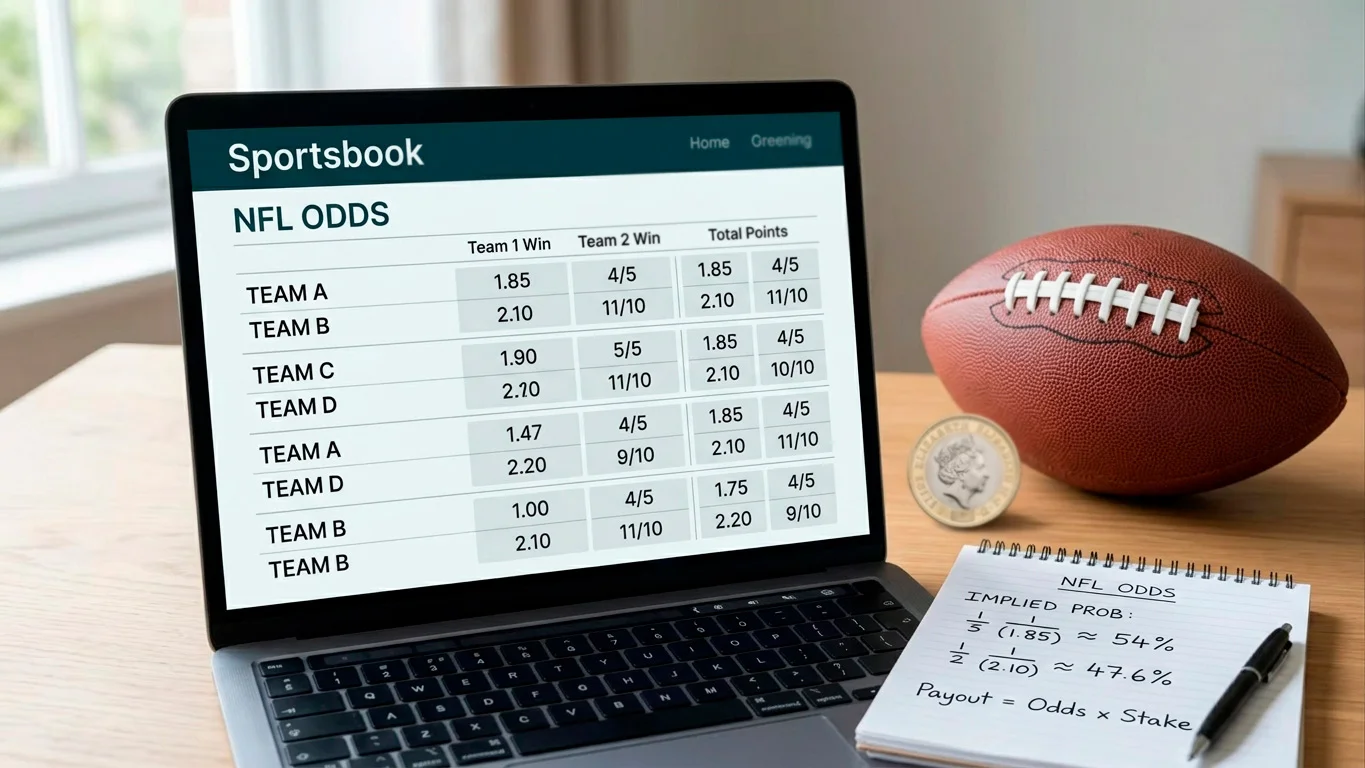
A few years ago, a reader emailed me a screenshot of two betting slips. Both were moneyline bets on the same NFL game, placed at different UK bookmakers within 10 minutes of each other. One slip showed odds of 4/6, the other 8/11. He wanted to know which was the better bet. They were identical in implied probability — roughly 60% — but the way UK bookmakers present NFL odds creates confusion that costs punters real money, because most people cannot convert between formats quickly enough to spot genuine price differences.
The UK sports betting market generates 2.48 billion pounds in annual gross gambling yield from sports alone, and NFL’s slice of that pie grows every season. Understanding how odds work is not a nice-to-have skill — it is the foundation of every profitable decision you will make. This guide strips away the confusion and gives you the tools to read, compare and evaluate NFL odds at any UK bookmaker.
Fractional vs Decimal NFL Odds
I grew up with fractional odds. 5/1, 11/4, 8/13 — they were the language of every betting shop in the country and they made intuitive sense once you internalised the basic mechanic: the first number is what you win, the second number is what you stake. Bet 1 pound at 5/1 and you win 5 pounds plus your stake back for a total return of 6 pounds. Simple.
Then decimal odds arrived, imported from European and Asian markets, and the younger generation of UK punters adopted them without a second thought. Decimal odds represent the total return per unit staked, including the stake itself. Those same 5/1 fractional odds become 6.00 in decimal. The 8/13 favourite becomes 1.615. Decimal odds are mathematically cleaner for comparison purposes because you do not need to perform a division to figure out implied probability.
The conversion formula is straightforward. To move from fractional to decimal: divide the first number by the second, then add 1. So 11/4 becomes (11 divided by 4) + 1 = 3.75. To go the other direction: subtract 1 from the decimal odds, then express the result as a fraction. 3.75 becomes 2.75, which is 11/4. Most UK bookmakers let you toggle between formats in your account settings, and I recommend keeping decimal as your default. It makes comparison shopping between operators faster, especially when one bookmaker lists 8/11 and another lists 4/5 — numbers that look different in fractional but are immediately comparable in decimal (1.727 vs 1.80).
American odds — the plus/minus format used in the US — appear occasionally on UK betting sites, particularly in NFL content imported from American-facing platforms. A +200 underdog translates to 2/1 fractional or 3.00 decimal. A -150 favourite translates to 2/3 fractional or 1.667 decimal. You will rarely need to work in American odds at a UK bookmaker, but understanding all three formats becomes useful if you are comparing UK prices with US sportsbooks for reference.
Implied Probability and Bookmaker Margin
Every set of odds contains a hidden number that tells you what the bookmaker believes. It is called implied probability, and it is the single most important concept in betting mathematics. If a bookmaker offers 2/1 on an NFL team, the implied probability is 33.3% — they believe (or at least price as though) that team wins one in every three times. If you believe the team wins 40% of the time, you have found a value bet. If you believe it wins 25% of the time, the price is too short.
Calculating implied probability from decimal odds is one division: 1 divided by the decimal odds. At 3.00 decimal, implied probability is 1/3.00 = 0.333, or 33.3%. At 1.80 decimal, it is 1/1.80 = 0.556, or 55.6%. From fractional odds, the formula is denominator divided by (numerator + denominator). At 5/1, implied probability is 1/(5+1) = 16.7%.
Here is where the bookmaker’s business model becomes visible. In a fair market with no margin, the implied probabilities of all outcomes in a market would add up to exactly 100%. A two-way NFL moneyline market would have one team at 55% and the other at 45%, summing to 100%. In reality, those same probabilities might be priced at 57% and 47%, summing to 104%. That extra 4% is the overround, also called the vig or the margin. It is the bookmaker’s built-in profit.
NFL moneyline margins at UK bookmakers typically run between 3% and 6% on game-day markets. Point spread and totals markets tend to be tighter — often 2.5% to 4.5% — because they are higher-volume markets where bookmakers compete more aggressively on price. Prop bet margins are wider, frequently reaching 7% to 10%, which is why price shopping on props delivers outsized returns relative to the effort involved.
I check the overround on every NFL market I consider betting into. If the overround exceeds 6% on a two-way market, I either find a better price elsewhere or pass entirely. Life is too short — and bankrolls too finite — to fight excessive margins.
Comparing NFL Odds Across UK Bookmakers
William Hill commands nearly 38% of PPC clicks in UK sports betting. That dominance is a marketing achievement, not a pricing one. In my experience tracking NFL odds across a full season, no single operator consistently offers the best price. The best-priced moneyline favourite rotates between three or four bookmakers week to week, and the best-priced underdog often sits at an entirely different operator.
My comparison process is brutally simple. Before placing any NFL bet, I open the same market at a minimum of four operators and record the decimal odds. The highest decimal number on my selection is where I place the bet. This takes 90 seconds, requires no mathematical sophistication and delivers measurable improvement in returns over a season.
The impact of consistent line shopping compounds across volume. A punter placing 100 NFL bets over a season at an average stake of 20 pounds who consistently takes the best available price instead of the first price they see will typically improve their net position by 3 to 5 percentage points over the season. On 2,000 pounds in total stakes, that is 60 to 100 pounds of additional value. Not life-changing on a per-bet basis, but undeniable over time.
Odds comparison sites exist for UK NFL betting, but I have found them less reliable for American football than for Premier League or horse racing. The NFL odds on some comparison platforms update slowly — particularly for midweek games or early-release lines — and a stale price on a comparison site is worse than no information at all because it creates false confidence. I prefer checking operators directly, which is why I keep four bookmaker apps on my phone’s home screen during the NFL season.
One more pattern worth noting: UK bookmakers tend to shade NFL odds toward the favourites more aggressively than US sportsbooks do. British punters, who are generally less familiar with NFL than with domestic football, gravitate toward backing the team they have heard of — which is usually the favourite. That customer behaviour pattern means UK underdog prices are often slightly more generous than their US equivalents. If you have a genuine analytical edge on underdog selections, UK markets can be more rewarding than the same bet placed in America.
Do UK bookmakers display NFL odds in American format?
Some UK bookmakers offer the option to display odds in American format alongside fractional and decimal, but it is not the default. You can usually switch formats in your account settings. Decimal odds are the most practical for quick comparison across operators, while fractional remains the traditional UK standard.
What is the average bookmaker margin on NFL markets?
NFL point spread and totals markets at UK bookmakers typically carry margins of 2.5% to 4.5%. Moneyline margins run slightly wider at 3% to 6%. Prop bet markets have the widest margins, often 7% to 10%. Margins vary by operator and by the profile of the fixture — primetime games tend to have tighter margins due to higher betting volume.
How often do NFL odds change before kickoff?
NFL odds move continuously from the moment they are released until kickoff. Significant movements typically follow injury reports on Wednesday through Friday, line moves from sharp bettors in the US market on Saturday and Sunday morning, and any breaking news about weather or last-minute roster changes. Early-week prices often differ substantially from kickoff prices.
Written by the editors at Free nfl Bets.