NFL Betting for Beginners: A UK Starter Guide
 Available in US

My first NFL bet was a disaster. It was Super Bowl Sunday, 2018, and I backed the New England Patriots on the moneyline because — well, because Tom Brady. I had no idea what a spread was, no concept of how American odds translated into UK fractional format, and I placed the bet at 3am after four pints. The Patriots lost, I lost 20 pounds, and the only thing I gained was a determination to understand what I was actually doing before putting money down again.
Eight years later, NFL betting is a meaningful part of my punting calendar. The journey from clueless to competent was not complicated, but it did require learning a few things that most betting guides either skip or bury in jargon. The UK’s online betting sector processes around 290 million bets on real-life events every month, and a growing share of those involve American football — a sport that more British fans are discovering each year through expanded Sky Sports coverage, London games at Tottenham Hotspur Stadium, and an increasingly global NFL brand.
This guide is for people who are curious about NFL betting but have not placed a bet yet, or who placed one and felt like they were guessing. Everything here is written from a UK perspective: odds in fractional format, times in GMT, money in pounds, and advice rooted in how UKGC-licensed bookmakers actually work.
Understanding the NFL Season and Schedule
If you are used to the Premier League’s August-to-May rhythm, the NFL calendar will feel refreshingly compact. The entire regular season fits inside 18 weeks, from early September to early January, with each of the 32 teams playing 17 games. That density is part of what makes NFL betting compelling — every game matters, there are no dead rubbers in October, and a single result can reshape the entire playoff picture.
The season divides into clear phases, and each one changes how you should think about betting. The first four weeks are volatile: new coaching schemes are still being installed, roster cuts have just been finalised, and teams are finding their identity. Historical data from previous seasons is less reliable here because offseason changes — free agency signings, draft picks, coaching hires — have not been tested under live conditions. Betting lines in September tend to be wider (bookmakers build in more margin) because the uncertainty is genuine.
From weeks five through twelve, the picture sharpens. You now have meaningful current-season data: how an offensive line is actually performing, which defences are stopping the run, which quarterbacks are turning the ball over. This is the period where informed bettors find the most consistent value, because the betting public still reacts to last season’s reputations while the numbers tell a different story. A team that finished 12-5 last year but starts 3-3 this year is still attracting public money based on its name, even though the spread should reflect its actual 2026 performance.
The playoffs begin in January and run through to the Super Bowl in February. The field narrows from 14 teams to one winner across four rounds: Wild Card, Divisional, Conference Championships and the Super Bowl itself. Playoff betting is different from regular-season betting in one important respect — the sample size is tiny. A team plays one game per week, elimination looms, and coaching adjustments between rounds can flip a matchup entirely. The Super Bowl alone generates extraordinary wagering volume, with projected handles in the billions globally.
Reading NFL Odds in UK Formats
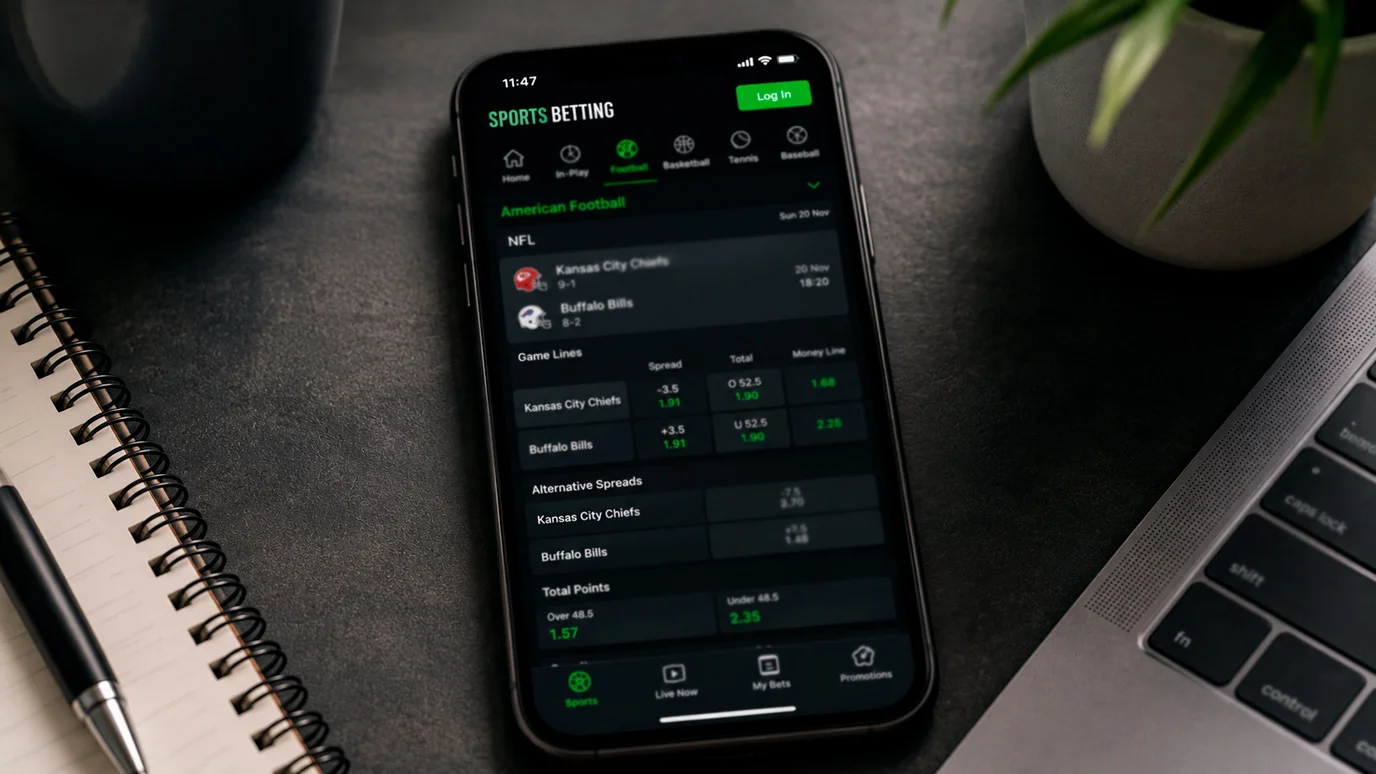
The first time I saw American odds on an NFL broadcast — Kansas City -150, Buffalo +130 — I had no idea what I was looking at. The negative and positive numbers bear no obvious relationship to the fractional odds that every British punter grows up with. The good news is that UK bookmakers display NFL odds in fractional format by default, so you rarely need to convert. But understanding what the numbers mean is essential if you want to evaluate whether a price represents value or whether the bookmaker has the edge.
Fractional odds tell you how much profit you make relative to your stake. If a team is priced at 6/4, you win 6 pounds for every 4 you stake — plus your stake back. The implied probability of 6/4 is calculated by dividing the denominator by the sum of both numbers: 4 divided by 10 equals 40 per cent. That means the bookmaker believes this team has roughly a 40 per cent chance of winning, though the actual implied probability is slightly lower because the odds include the bookmaker’s margin.
Decimal odds, which some UK sites offer as an alternative display, express the total return per pound staked. The same 6/4 bet appears as 2.50 in decimal format — stake 1 pound and get 2.50 back (1.50 profit plus your 1 pound stake). Decimal is simpler for comparing prices across different bookmakers because higher numbers always mean higher returns.
The crucial concept for new bettors is the overround — the built-in margin that ensures the bookmaker profits over time. In a two-outcome NFL market (moneyline on a game with no draw), fair odds would produce implied probabilities totalling exactly 100 per cent. In practice, the combined implied probability might total 105 or 106 per cent. That extra 5 or 6 per cent is the bookmaker’s edge. The lower the overround, the better the value for the bettor. Comparing overrounds across bookmakers for the same NFL game is one of the simplest ways to ensure you are getting the best available price, and it takes less than a minute once you know what to look for.
Placing Your First NFL Bet
Forget the exotic markets, the six-leg accumulators and the same-game parlays. Your first NFL bet should be the simplest wager the bookmaker offers: a single moneyline bet on one team to win one game. Nothing else. I am serious about this, and I will explain why.
A moneyline bet removes every variable except the most fundamental question in sport: which team wins? You do not need to worry about the margin of victory (that is the spread), the total number of points scored (that is the over/under), or any individual player’s performance (that is a prop). You watch the game, your team either wins or it does not, and your bet settles accordingly. The simplicity lets you focus on learning how the betting process works — funding your account, navigating the app, finding the NFL section, placing the bet, watching it settle — without the cognitive overhead of understanding complex market mechanics.
To place your first bet at a UKGC-licensed bookmaker, you need to register an account, verify your identity (a regulatory requirement, not optional), and deposit funds. The verification process typically involves uploading a photo ID and a proof of address. The 2023 UKGC survey found that 65 per cent of respondents would refuse to submit documents for verification, which reveals a gap between what people expect and what the law requires. It is worth knowing upfront: you cannot skip this step, every licensed operator must do it, and it protects you as much as it protects them.
Once your account is funded, find an upcoming NFL game that you have at least some knowledge about — a team you have watched, a matchup you have read about, a game featured on Sky Sports that week. Check the moneyline odds at two or three bookmakers to see which offers the best price on your selection. Place the bet, write down what you wagered and why, and watch the game. Whether you win or lose, you now have a reference point for every decision that follows.
Setting a Budget and Staking Plan
Here is a question I ask every new bettor I speak to: how much money can you lose this month without it affecting your rent, your bills or your mood? Whatever that number is, write it down. That is your bankroll. Not your savings, not your disposable income, not what you could afford if things go well — the amount you can lose entirely and walk away from without regret.
The NFL season runs roughly 23 weeks from the first regular-season game to the Super Bowl. If your monthly entertainment budget for betting is 80 pounds, your seasonal bankroll is around 180 pounds (assuming you spread it across September through February). Divide that by the number of weeks you plan to bet, and you have a weekly allocation. Mine works out to about 8 pounds per week during the regular season, increasing slightly during the playoffs when I am more selective and there are fewer games.
Flat staking — betting the same amount on every selection regardless of confidence — is the approach I recommend for beginners, and the one I still use for most of my NFL bets. The logic is straightforward: confidence is subjective and unreliable, especially when you are new. The game you feel certain about is no more likely to win than the game you are lukewarm on, because your “certainty” is based on incomplete analysis. Flat staking removes that variable and forces you to focus on selection quality rather than stake manipulation.
A common flat stake is 1 to 2 per cent of your total bankroll per bet. On a 180-pound seasonal bankroll, that is 1.80 to 3.60 per bet. Those numbers feel small, and they should. The goal in your first season is not to make money — it is to learn how NFL betting works without losing enough to make the experience painful. If you finish your first season with 120 pounds of your original 180, you have paid 60 pounds for an education that will serve you for years. That is cheaper than most courses.
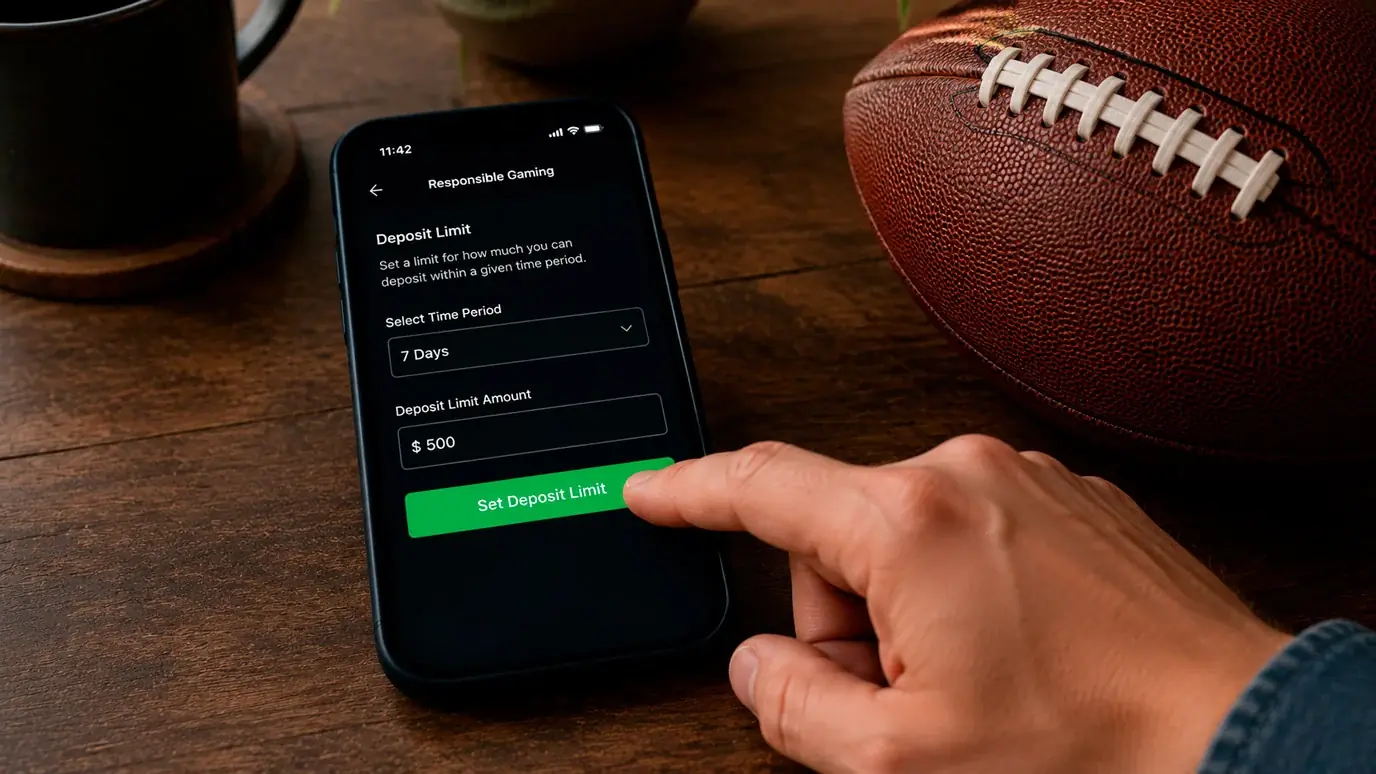
Every UKGC-licensed bookmaker is required to offer deposit limits, and setting one is the single most effective way to enforce your budget. When you register, the site will ask whether you want to set a daily, weekly or monthly deposit cap. Set it to your monthly allocation and forget about it. The system will physically prevent you from depositing more than that amount, which removes the temptation entirely. Operators are also required to conduct financial vulnerability checks when net deposits exceed 150 pounds within a 30-day window — a regulatory measure introduced to protect bettors from spending beyond their means. These checks are not punitive; they exist because the Gambling Commission takes affordability seriously, and understanding them upfront means they will not surprise you later.
Five Mistakes New NFL Bettors Make
I have made every one of these mistakes, some of them more than once. Listing them here is not about finger-wagging — it is about saving you the tuition fees I paid in lost bets.
The first and most expensive mistake is betting on your favourite team every week. Emotional attachment clouds judgment. I support a team with a mediocre quarterback and an ageing defence, and if I bet on them to cover the spread every Sunday, I would be bankrupt by November. Your fandom and your betting need to exist in separate compartments. If you cannot bet against your team when the data says you should, do not bet on their games at all.
The second mistake is chasing losses. You lose your first bet of the evening, so you double your stake on the second game to “get it back.” This is the single fastest way to empty a bankroll, and in-play betting makes it worse because there is always another market, another game, another chance to recover. The maths is unforgiving: after losing a 5-pound bet and doubling to 10, you now need to win just to break even. After two losses and a third doubling, you are 35 pounds deep on what started as a 5-pound position.
Third: ignoring the schedule. NFL teams that played on Thursday night and then have a Sunday game are operating on a short week. Teams coming off a bye week are rested. Cross-country travel matters — a team flying from the east coast to the west coast for a late kickoff is dealing with a three-hour time zone shift that research has consistently shown affects performance. These factors are baked into the odds to some degree, but not always fully, especially in earlier weeks when the market has less data to work with.
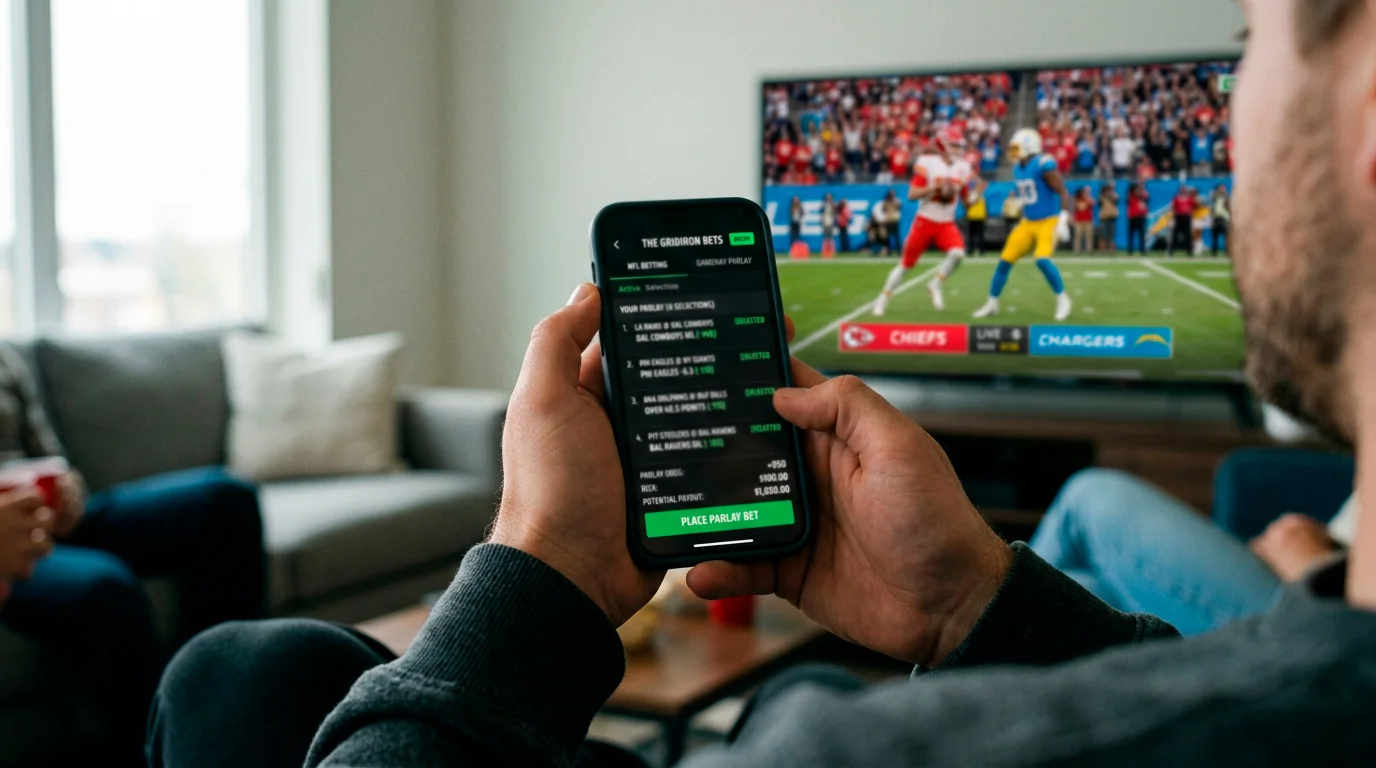
Fourth: loading up on parlays because the potential payout looks exciting. Accumulators are fun, and the idea of turning 5 pounds into 150 is attractive. The problem is that each leg you add multiplies the bookmaker’s edge. A three-leg parlay where each selection has a 5 per cent bookmaker margin carries a compounded edge of roughly 14 per cent. Six legs pushes it past 25 per cent. The different NFL bet types each carry their own risk profile, and understanding that before you start combining them into accumulators will save you money.
Fifth: not shopping for odds. The difference between 5/4 and 6/5 on the same selection changes your long-term return dramatically. Over 100 bets, the bettor consistently taking the better price will be meaningfully ahead of the one accepting whatever is on screen. Checking two or three bookmakers before placing a bet takes 30 seconds and costs nothing.
How to Follow NFL Games in the UK
You cannot bet intelligently on games you do not watch. That sounds obvious, but the number of people who bet on NFL based purely on statistics they read on Monday morning — without having seen a single snap of the game in question — is higher than you would think. Watching games builds pattern recognition that no stat sheet can replicate: how a quarterback responds to pressure, whether an offensive line is holding up in the fourth quarter, how a team adjusts at half-time.
Sky Sports is the primary NFL broadcaster in the UK, and their coverage has expanded substantially. The new multi-year deal increased regular-season game coverage by 50 per cent compared to previous arrangements, giving UK viewers access to more live games than at any point in the sport’s British broadcasting history. Sky’s NFL coverage includes studio analysis, RedZone (a channel that cuts between all live games to show every scoring play), and dedicated match broadcasts with UK-based commentary teams who do a good job of explaining the game without talking down to knowledgeable fans.
Channel 5 holds the free-to-air NFL rights, broadcasting a more limited schedule without requiring a subscription. For a new bettor on a budget, Channel 5’s games are the obvious starting point — free football, visible to the general public, with enough coverage to follow at least one game per week during the regular season.
If you want to experience NFL live, the London games at Wembley and Tottenham Hotspur Stadium are worth attending at least once. Tottenham’s ground is the only stadium outside America purpose-built for American football, and the atmosphere on game day is unlike anything else in the UK sporting calendar. The NFL has more than 13 million fans in the UK, roughly 4 million of them self-described avid supporters, and the London games are where that community becomes visible. From a betting perspective, attending a game teaches you things no broadcast can — how loud the crowd gets on third down, how disruptive a hostile atmosphere is for the visiting team’s snap count, how weather conditions actually feel at pitch level versus how they look on a camera feed. Henry Hodgson, the NFL’s GM for the UK and Ireland, has noted that fandom is growing at every level, with viewership, engagement and social media numbers all trending upward — and the betting market is following.
The NFL’s own Game Pass service offers a comprehensive option for dedicated fans: every game, live and on demand, plus coaches’ film (the all-22 angle that shows every player on the field). Game Pass is a subscription product, but it provides the depth of coverage that serious bettors eventually want. The league’s international push is accelerating — the global sports betting market currently stands at roughly 100.9 billion dollars, and the NFL is positioning itself to capture a larger share of that figure through expanded broadcasting and the growing London and Dublin game schedule. Bill Miller, the American Gaming Association’s president, put it plainly when he said the Super Bowl has become the most-bet sporting event in American history, and that momentum is crossing the Atlantic.
FAQ: Getting Started With NFL Betting
Do I need to understand American football to bet on the NFL?
You need a basic understanding of the rules — how scoring works, what downs are, and how the game clock operates. You do not need to be an expert. Start by watching a few games on Channel 5 or Sky Sports before placing your first bet. Pattern recognition from watching games is more valuable than memorising statistics.
What is the minimum bet on NFL games at UK bookmakers?
Most UKGC-licensed bookmakers set their minimum stake at 10p to 1 pound, depending on the operator and market type. For beginners, starting with small stakes — even the minimum — is the right approach while you learn how NFL betting works.
Are NFL betting odds different from football odds?
The format is the same at UK bookmakers — fractional or decimal, your choice. The key difference is the types of markets available. NFL betting includes point spreads, totals, player props and futures that do not have direct equivalents in football betting. The bookmaker margin on NFL markets tends to be slightly wider than on Premier League matches because there is less betting volume.
When does the NFL season start and end?
The regular season typically runs from early September to early January, with 17 games per team across 18 weeks. The playoffs follow in January, culminating in the Super Bowl in February. Pre-season games in August are available for betting but carry much higher uncertainty because teams rest key players and test new schemes.
Created by the ”Free nfl Bets” editorial team.